Effective biodiversity management is a key Indicator in sustaining palm oil plantation operations, particularly in meeting Environmental, Social, and Governance (ESG) standards. In this context, the presence of primates serves as an important indicator of ecosystem quality within the operational are...
Effective biodiversity management is a key Indicator in sustaining palm oil plantation operations, particularly in meeting Environmental, Social, and Governance (ESG) standards. In this context, the presence of primates serves as an important indicator of ecosystem quality within the operational areas of PT Teladan Prima Agro Tbk (TPA).
Primates are a group of mammals that include monkeys, slow lorises, and apes, playing a vital role in maintaining forest ecosystem balance. Indonesia is home to 59 primate species distributed across various habitats, including tropical rainforests, savannas, and wetlands across Sumatra, Kalimantan, Java, and Sulawesi, with 15 species found in Kalimantan alone. Within TPA’s High Conservation Value (HCV) areas, identified primates belong to the Cercopithecidae (monkeys and langurs), Hylobatidae (gibbons), Lorisidae (slow lorises), and Pongidae (orangutans) families.
Primate diversity and populations are highly influenced by environmental carrying capacity, particularly the availability and quality of habitat. Ongoing deforestation pressures in various regions continue to affect primate populations. In this context, TPA, as a company committed to sustainability principles, contributes to preserving habitat potential through the management of HCV areas, which play a crucial role in supporting primate survival.
Primates are not only integral components of the ecosystem but also directly contribute to vegetation regeneration and enrichment. Species such as the red langur (Presbytis rubicunda) and Müller’s gibbon (Hylobates muelleri) support forest regeneration through effective seed dispersal across various forest areas. Meanwhile, the orangutan (Pongo pygmaeus) plays a role in maintaining ecosystem dynamics, including canopy opening and supporting pollination processes.
Furthermore, primates serve as key indicators of forest health. As species highly sensitive to habitat changes, their presence reflects ecosystem quality, food availability, and the integrity of forest structure. Therefore, primate population trends are not only relevant from a conservation perspective but also provide insights into land management effectiveness and the sustainability of long-term productivity.
All primate species identified within TPA’s operational areas are protected under Government Regulation No. 106 of 2018. Globally, most are classified as Endangered (EN) and Critically Endangered (CR) by the International Union for Conservation of Nature (IUCN), and are listed under Appendix I and II of the Convention on International Trade in Endangered Species of Wild Fauna and Flora (CITES), which restrict international trade.
TPA, in collaboration with Ecositrop, has been consistently conducting biodiversity monitoring and evaluation. Primate observations are carried out through direct field encounters, line transects, and photographic documentation. Data collected from 2020 to 2025 provides insights into population trends and distribution patterns across all TPA operational units.
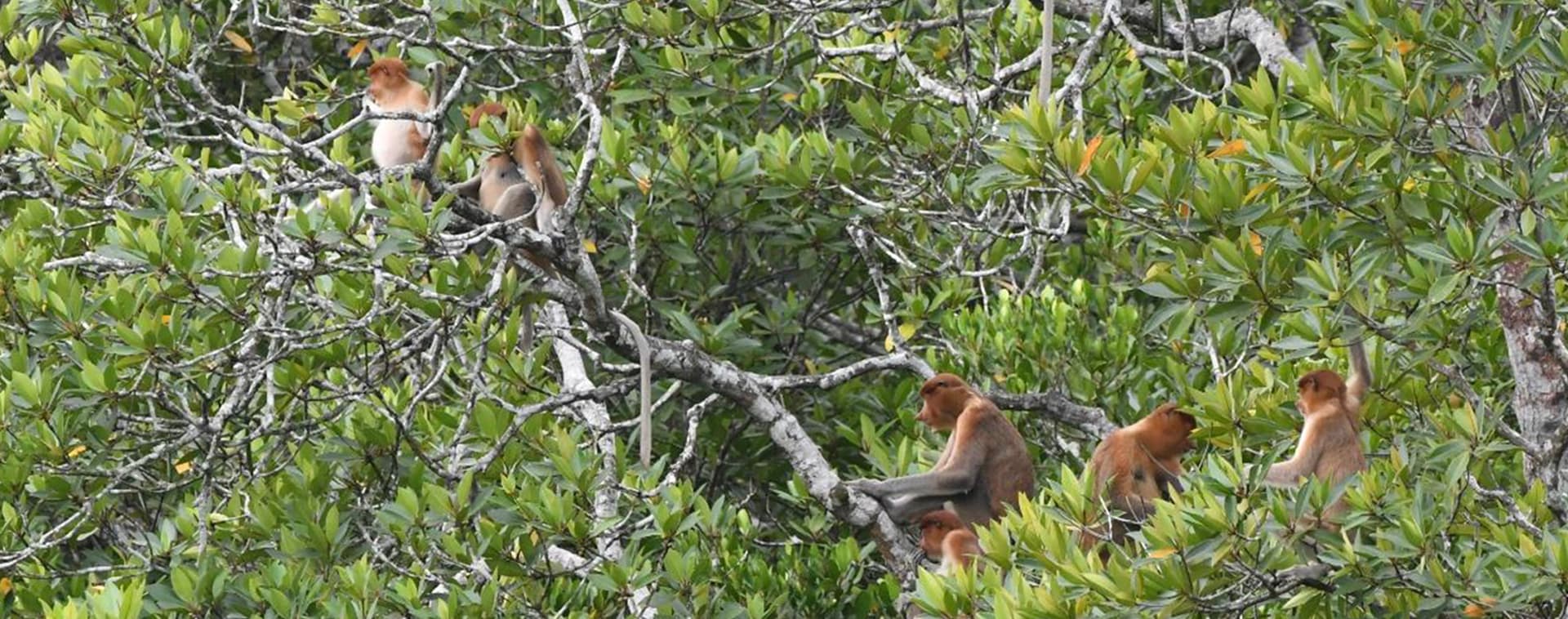
Monitoring results indicate that primate encounter rates over the past six years have shown dynamic fluctuations. Species such as long-tailed macaques and pig-tailed macaques recorded significant increases up to 2024, indicating strong adaptability to the mosaic landscape of plantation and forest areas. Although a decline was observed in 2025, both species remain the most dominant within the landscape.
Orangutans, classified as Critically Endangered (CR) by the International Union for Conservation of Nature (IUCN), remain a primary focus of conservation efforts at TPA. Monitoring data shows a relatively stable population, ranging between 13–16 individuals annually. Their continued presence indicates that TPA’s HCV areas still provide adequate food sources as well as safe movement corridors for the species.
These findings reaffirm the importance of sustainable HCV management as an integral part of TPA’s commitment to biodiversity conservation. Consistent monitoring efforts and habitat protection support the survival of primates, including key species such as orangutans, while maintaining optimal forest ecological functions. Moving forward, TPA will continue to strengthen conservation-based management practices to ensure a balance between business growth and environmental sustainability.