Documentation by Katadata
JAKARTA – The Government and the House of Representatives (DPR RI) have enacted Law (UU) Number 1 of 2023 concerning the Criminal Code (KUHP) on January 2, 2023, which will officially take effect on January 2, 2026. Under the new KUHP, provisions on corporate criminal liability will certainly affect palm oil plantation companies.
Professor of Criminal Law at the Faculty of Law, University of Indonesia, Topo Santoso, stated that Article 2 of the new KUHP governs the living law, referring to laws that live within society, such as customary criminal law (tindak pidana adat). This is important for palm oil companies to understand because their business operations are in regions that apply customary norms. Later, sanctions for customary criminal acts will be stipulated in government regulations (PP) and regional regulations (Perda), as each region has different customary laws.
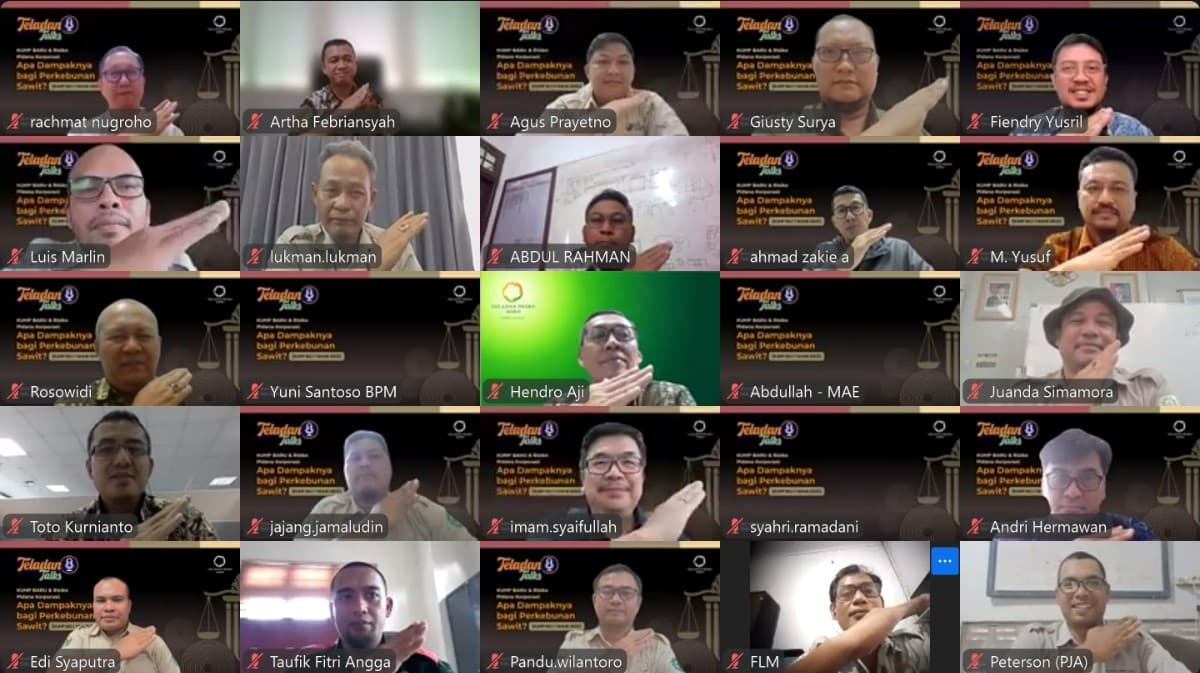
“So later, the technical regulations regarding customary criminal acts will be drafted through PP, and each region will create its own Perda,” said Topo during the event organized by PT Teladan Prima Agro Tbk, Teladan Talks: New KUHP and Corporate Criminal Risk, on Friday, December 5, 2025.
Topo emphasized that the provisions in the new KUHP clarify several aspects, including the definition/scope of corporations, recognition of corporations as subjects of criminal acts, the definition/limits of criminal acts committed by corporations, the definition/limits of corporate criminal liability, models of corporate liability, and grounds for exemption from criminal punishment for corporations.
In the new KUHP, when imposing penalties against corporations, several considerations must be considered, as stated in Article 56, and the principle of restorative justice must be prioritized. This is reflected in Article 70 paragraph (1), which states that imprisonment should, as far as possible, not be imposed if the defendant has compensated the victim and fulfilled other conditions. Article 54, paragraph (2), of the KUHP also states that judges may decide not to impose a punishment or act.
“For example, if the defendant is willing to pay fines, admit wrongdoing, and commit not to repeat the offense, the case does not need to proceed to prosecution or court. This is more effective because appeals take a long time and so on,” he explained.
Furthermore, Topo explained that punishment and measures against corporations under the KUHP include principal penalties, such as fines, and additional penalties, including compensation, remediation of the impacts of criminal acts, fulfillment of customary obligations, and funding for job training, as outlined in Article 120.
Additionally, the KUHP allows measures such as the government takeover of the corporation, funding for training, placing the corporation under supervision, and/or placing it under guardianship as preventive measures to avoid repeated violations. To avoid such legal consequences, companies must strengthen standard operating procedures (SOP) and ensure the effectiveness of internal controls across all operational lines as a primary step in maintaining compliance.
Meanwhile, Head of Legal Litigation & Government Relations of TPA, Muhammad Shevy, stated that the purpose of holding this Teladan Talks session was to provide TPA employees with an understanding and information regarding the changes in the new KUHP, so that the company can strengthen governance, update compliance systems, and enhance risk management in facing the complexities of operations in the plantation sector. With a firm understanding, every employee is expected to actively participate in ensuring that the company remains within the legal framework.