Documentation by Katadata
JAKARTA – The anti-corruption policy is part of the implementation of good corporate governance (GCG), which continues to be carried out by PT Teladan Prima Agro Tbk (TLDN) or TPA as a public company that consistently complies with applicable regulations. Naturally, the anti-corruption policy must also accommodate regulatory changes, considering that the government and the House of Representatives (DPR RI) have ratified Law (UU) Number 1 of 2023 concerning the new Criminal Code (KUHP), which will take effect on January 2, 2026.
Under the new KUHP, corporations are treated as general subjects of criminal law. Furthermore, as stated in Article 45, paragraph (1) of the KUHP, corporations can be held accountable for criminal acts due to their status as subjects of criminal law. There are new qualifications under which a corporation can be held criminally responsible—for example, if it allows a criminal act to occur or fails to take the necessary measures to prevent it.
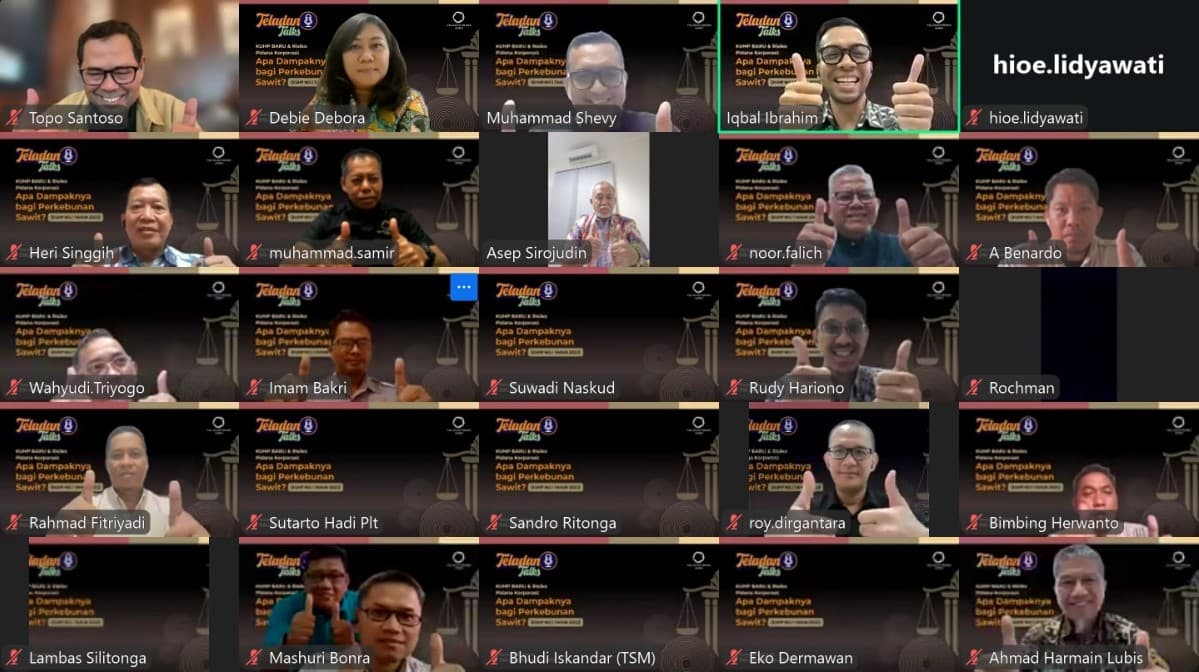
Professor of Criminal Law at the Faculty of Law, University of Indonesia, Topo Santoso, explained that criminal liability of corporations can be imposed only if there are wrongful acts and criminal intent, or mens rea. “Therefore, a corporation can only be held accountable for a criminal act if there is actus reus (the act) and mens rea (criminal intent/deliberateness),” said Topo in the Teladan Talks event held on Friday, December 5, 2025.
Topo added that to protect corporations from criminal acts, companies should conduct oversight through internal policies or anti-corruption standard operating procedures (SOPs). Such anti-corruption policies must accommodate the provisions of Article 48 of the new KUHP. “This becomes crucial because if a corporation fails to take preventive measures, ensure compliance, or allows a criminal act to occur, then the corporation may be subject to criminal liability,” he said.
The regulation states that a corporation may be held liable if the criminal act falls within its business scope, unlawfully benefits the corporation, is accepted as a corporate policy, no preventive measures are taken, and/or the corporation allows the criminal act to occur.
For information, TPA enacted the Anti-Corruption and Anti-Bribery Guidelines on November 24, 2023. This policy has also mitigated actions classified under mens rea and aligns with ISO 37001 standards. This initiative reflects TPA’s commitment to creating an environment free of corruption by ensuring that all operational activities are carried out in accordance with prevailing policies.
Under the Anti-Corruption and Anti-Bribery Guidelines, TPA is expected to prevent material and immaterial losses that may disrupt business continuity. This regulation was also designed to foster awareness among all stakeholders of the importance of prioritizing clean and responsible business practices in accordance with good corporate governance.
In addition, it aims to strengthen the company’s compliance and discipline with laws, regulations, and ethics, and ultimately to foster a high ethical culture in carrying out work activities involving external parties, such as business partners and government institutions associated with the company.
Complete information regarding TPA’s Anti-Corruption and Anti-Bribery Guidelines can be accessed through the following link: https://www.teladanprima.com/en/gcg/policy-system/