Documentation by Katadata
JAKARTA – The utilization of remote sensing technology is increasingly vital for palm oil plantation companies. This effort has been implemented by PT Teladan Prima Agro Tbk (TLDN) or TPA through Teladan Productivity Technology Science (TPTS). The initiative aims to optimize palm oil plantation yields in accordance with the potential of planted land, enabling production increases without opening new areas. This approach also supports TPA's commitment to sustainability.
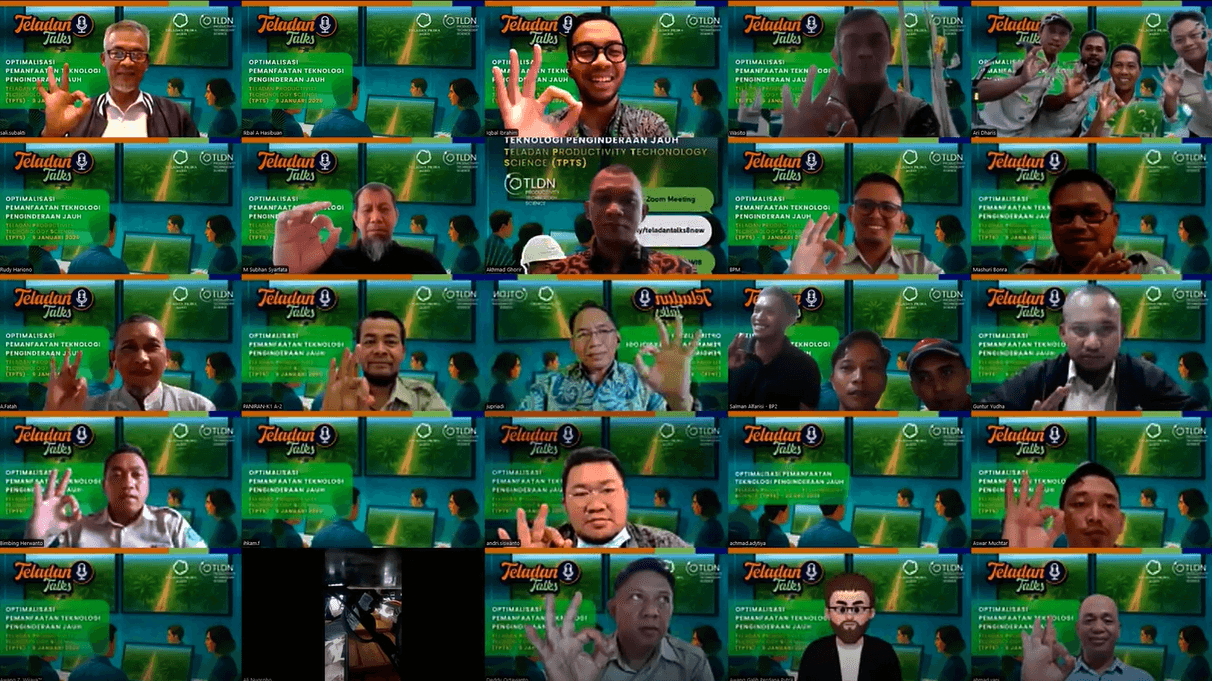
To further explain the working mechanism and application of remote sensing technology through TPTS, TPA held a Teladan Talks session themed "Optimizing the Utilization of Remote Sensing Technology" on January 9, 2026. The session featured Sali Subakti, Head of the Precision Agriculture Section of TPA, as the speaker. He explained that TPTS is currently capable of monitoring the entire operational area of TPA's palm oil plantations spread across Berau Regency, East Kutai Regency, Kutai Kartanegara Regency, and Paser Regency through a plantation monitoring system based on satellite imagery and drones.
Figure 1. TPTS Workflow and Applications
In practice, TPTS collects and monitors data and information related to productivity and technical cultivation practices, climate and weather anomalies, plant health, nutrient status, pest and disease infestations, environmental changes within plantation areas, and other factors that may affect production potential and actual output. The acquisition of this multi-complex data is subsequently processed using machine learning and deep learning (ML/DL) model algorithms, which form the basis for artificial intelligence (AI)–based detection and prediction systems within TPTS.
Based on this big data analytics/science approach, management and operational or field teams can quickly identify area variability, plant health anomalies, and current area potential. Subsequently, based on the collected data, field teams conduct ground checks/truthing to confirm and validate indications of factors that may limit production and cause yield gaps, as well as site-specific yield potential in each plantation block over the next 3 to 24 months.
Sali explained that, through the TPTS detection and prediction information system, an Estate Manager and assistants can quickly and proactively direct supervisory staff and field workers to focus on and resolve issues in specific blocks in a more precise, data-driven manner. Furthermore, the TPTS team, through a control room located at TPA's head office, measures the impact of environmental anomalies such as the El Niño–Southern Oscillation (ENSO), extreme temperature and rainfall events, block-level microclimates, and lag-time periods on vegetation and plant health indices, the Fresh Fruit Bunch Loss Index (FFBLI), and water storage conditions in each production block.
"This is very important because climate and environmental factors are dynamic and difficult to predict (uncontrollable factors), yet they significantly influence plant health conditions and the process of forming the number and weight of bunches per palm, or fresh fruit bunch (FFB) production, in each specific and unique planting block. This serves as the foundation for the development of a TPTS hybrid prediction system to strengthen periodic production census results, which began pilot implementation in 2025 in parallel with ground-truthing for model calibration and error evaluation," Sali said during the 8th edition of Teladan Talks.
Figure 2. TPTS Control Room at Head Office
"There are more than 8 million palm trees within the plantation areas managed by operations. Through TPTS, the company can quickly monitor these millions of palms without visiting each one individually. The use of remote sensing has become essential as we directly face spatial and temporal variability in the field," Sali added.
From a business sustainability perspective, Sali stated that TPTS, supported by well-targeted execution through a site-specific nutrient management (SSNM) framework in the field, provides scientific and objective evidence to address negative black campaigns against palm oil—particularly those related to deforestation. In addition, challenges such as price fluctuations and rising production costs can be better managed through improved data quality and continued investment in TPTS technology.
Figure 3. Site-Specific Nutrient Management (SSNM) with TPTS Variable Rate Fertilizer Technology
On the other hand, Sali noted that TPTS encourages a shift from reactive to proactive processes, delivering precise treatments tailored to each palm tree's needs (for example, in fertilizer application). Through TPTS detection capabilities, management and field operational teams can carry out rapid precision interventions, as each block has different nutritional requirements.
"Based on the quality of TPTS data and technological support, fertilizer and pesticide doses can be applied in accordance with the 5T principles and nutrient balance/minimum requirements, reducing input waste by approximately 20%–30%. The technology adopted by TPTS has transformed traditional, often reactive (habit-based) or uniform operational practices into predictive and proactive, data-driven management approaches (no 'one size fits all')," Sali explained.
"The application of remote sensing technology using multispectral and hyperspectral sensors in TPTS is like an 'eagle eye' in the skies over TPA's plantations, helping us identify what cannot be seen with the naked eye across every inch of land and every palm planting point. As a result, we can obtain information quickly, in real time, and with validated accuracy levels exceeding 95% confidence through ultra-high-resolution sensors," he said.
Sali added that, based on satellite imagery, TPTS continuously conducts ground-truthing and block-level task scouting through team observations and drone monitoring to confirm and validate data, achieving very high accuracy—even down to the individual planting point or palm tree level—through the development of SSNM and TPTS Tree-ID geocoding.
"TPTS embodies the spirit and mandate for all TLDN personnel that every planted palm must be protected and cared for, because every palm truly matters," Sali concluded.